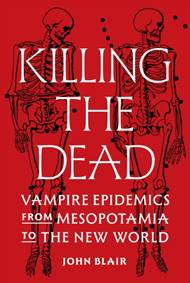
Killing the Dead
Knihu kúpite v
1 e-shope
od
47,03 €
Ak sa vám po kliknutí na tlačidlo "Do obchodu" nezobrazí stránka knihy vo vybranom e-shope, je potrebné vypnúť AdBlock vo vašom prehliadači pre našu stránku.
Návod na vypnutie je napríklad na adrese https://www.sme.sk/dok/20466299/ako-vypnut-adblock-na-sme-sk-whitelist.
Krátky popis
A riveting history of vampire panics across cultures and down
through the millennia—and why killing the dead is better than
killing the livingKilling the Dead provides the first in-depth,
global account of one of the world’s most widespread yet
misunderstood forms of mass hysteria—the vampire epidemic. In a
spellbinding narrative, John Blair takes readers from ancient
Mesopotamia to present-day Haiti to explore a macabre frontier of
life and death where corpses are believed to wander or do harm from
the grave, and where the vampire is a physical expression of
society’s inexplicable terrors and anxieties. In 1732, the British
public opened their morning papers to read of lurid happenings in
eastern Europe.Serbian villagers had dug up several corpses and had
found them to be undecayed and bloated with blood. Recognizing the
marks of vampirism, they mutilated and burned them. Centuries
earlier, the English themselves engaged in the same behavior.In
fact, vampire epidemics have flared up throughout history—in
ancient Assyria, China, and Rome, medieval and early modern Europe,
and the Americas. Blair blends the latest findings in archaeology,
anthropology, and psychology with vampire lore from literature and
popular culture to show how these episodes occur at traumatic
moments in societies that upend all sense of security, and how the
European vampire is just one species in a larger family of
predatory supernatural entities that includes the female flying
demons of Southeast Asia and the lustful yoginis of India. Richly
illustrated, Killing the Dead provocatively argues that
corpse-killing, far from being pathological or unhealthy, served as
a therapeutic and largely harmless outlet for fear, hatred, and
paranoia that would otherwise result in violence against
marginalized groups and individuals.
Výber kníh autorov
Princeton University Press ,
John Blair

Zobraziť všetky knihy autora
Princeton University Press,
John Blair
Výber kníh vydavateľa
Slovart

Zobraziť všetky knihy vydavateľa
Slovart
Naše tipy