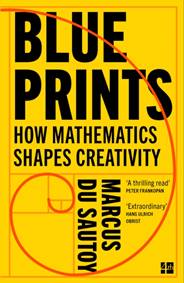
Blueprints
Knihu kúpite v
1 e-shope
od
15,15 €
Ak sa vám po kliknutí na tlačidlo "Do obchodu" nezobrazí stránka knihy vo vybranom e-shope, je potrebné vypnúť AdBlock vo vašom prehliadači pre našu stránku.
Návod na vypnutie je napríklad na adrese https://www.sme.sk/dok/20466299/ako-vypnut-adblock-na-sme-sk-whitelist.
Krátky popis
*A Financial Times and Waterstones Book of the Year 2025* Many
artists are unaware of the mathematics that bubble beneath their
craft, while some consciously use it for inspiration. Our instincts
might tell us that these two subjects are incompatible forces with
nothing in common, but what if we’re wrong? Marcus du Sautoy,
acclaimed mathematician and Simonyi Professor for the Public
Understanding of Science at the University of Oxford, looks to art,
music, design and literature to uncover the key mathematical
structures that underpin both human creativity and the natural
world. Blueprints takes us from the earliest stone circles to the
modernist architecture of Le Corbusier, from Bach’s circular
compositions to Radiohead’s disruptive soundscapes, and from
Shakespeare’s hidden numerical clues to the Dada artists who
embraced randomness. Instead of polar opposites we find a
complementary relationship that spans a vast historical and
geographic landscape. Whether we are searching for meaning in an
abstract painting or deciphering poetry, there are blueprints
everywhere: prime numbers, symmetry, fractals and the weirder
worlds of Hamiltonian cycles and hyperbolic geometry. Nature
similarly exploits these structures to achieve the wonders of our
universe. In this innovative and delightfully bold exploration of
creativity, Marcus explains how we make art, why a creative mindset
is vital for discovering new mathematics and how a fundamental
connection to the natural world intrinsically links these two
subjects. ‘Blueprints is an extraordinary book which shows us how
mathematics and art are connected through structures. Du Sautoy
shows us how to bridge the divide of science and the humanities and
proves that we can only face and solve the big challenges of the
twenty-first century if we go beyond the fear of pooling knowledge’
Hans Ulrich Obrist, Artistic Director, Serpentine Galleries
Výber kníh autorov
du Sautoy Marcus ,
HarperCollins Publishers






Zobraziť všetky knihy autora
du Sautoy Marcus,
HarperCollins Publishers
Výber kníh vydavateľa
Slovart
Zobraziť všetky knihy vydavateľa
Slovart
Naše tipy