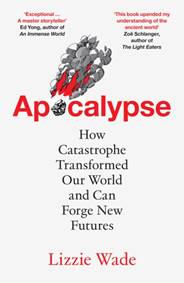
Apocalypse
Knihu kúpite v
1 e-shope
od
15,15 €
Ak sa vám po kliknutí na tlačidlo "Do obchodu" nezobrazí stránka knihy vo vybranom e-shope, je potrebné vypnúť AdBlock vo vašom prehliadači pre našu stránku.
Návod na vypnutie je napríklad na adrese https://www.sme.sk/dok/20466299/ako-vypnut-adblock-na-sme-sk-whitelist.
Krátky popis
A groundbreaking new perspective on catastrophes throughout human
history, with vital lessons for our future 'This book upended my
understanding of the ancient world' Zoë Schlanger, author of The
Light Eaters 'Lizzie Wade is an exceptional journalist and a master
storyteller' Ed Yong, author of An Immense World The history of
humanity is one of devastating, once-in-a-thousand-year events:
rising seas that make land uninhabitable, decades-long droughts,
civilisational collapse, epidemics like the Black Death and the
Spanish Flu that reduce a city’s population by fifty percent. And
yet, despite enormous destruction and very real tragedy, these
catastrophes all share one common denominator: we survived. In
APOCALYPSE, Lizzie Wade reframes the story of human history to show
how we can learn from these apocalyptic moments, seeing them not
just as violent, world-ending events but as moments of progress and
transformation. We travel back in deep time to when homo sapiens
replaced other human species including the Neanderthals, witness
the fall of the kingdom of Old Egypt, the end of the Mayans and the
Black Death, as well as lesser-known catastrophes. To weave this
unique narrative, Lizzie introduces us to a new generation of
archaeologists using cutting-edge technology to tell new stories
about our deep past, including flying planes equipped with lasers
over Mayan ruins deep in the jungle, scuba diving to the bottom of
the ocean, and sequencing the DNA of ancient people to show how we
are far more connected to our ancestors than we think. Written in a
gripping style that reads like an Indiana Jones mystery, APOCALYPSE
offers a refreshingly optimistic take on the crises our own
generation and those after us will face – arguing that yes,
catastrophes are painful and destructive, but we can and will
survive them.
Výber kníh autorov
HarperCollins Publishers ,
Lizzie Wade






Zobraziť všetky knihy autora
HarperCollins Publishers,
Lizzie Wade
Výber kníh vydavateľa
Slovart

Zobraziť všetky knihy vydavateľa
Slovart
Naše tipy