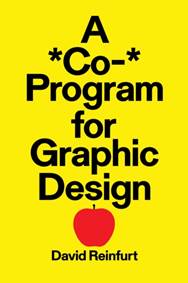
A *Co-* Program for Graphic Design
Knihu kúpite v
1 e-shope
od
29,40 €
Ak sa vám po kliknutí na tlačidlo "Do obchodu" nezobrazí stránka knihy vo vybranom e-shope, je potrebné vypnúť AdBlock vo vašom prehliadači pre našu stránku.
Návod na vypnutie je napríklad na adrese https://www.sme.sk/dok/20466299/ako-vypnut-adblock-na-sme-sk-whitelist.
Krátky popis
Three new graphic design courses, detailed in this volume, comprise
a critical companion to Reinfurt’s bestselling DIY textbook, A
*New* Program for Graphic DesignThis volume expands David
Reinfurt’s uniquely pragmatic and experimental approach to pedagogy
into a collaborative project that weaves together a multiplicity of
voices to present a polyphonic approach to design history and
teaching. Three of Reinfurt’s new Princeton University graphic
design courses—C-i-r-c-u-l-a-t-i-o-n, M-u-l-t-p-l-i-c-i-t-y and
R-e-s-e-a-r-c-h—developed explicitly in the context of remote
teaching and in light of urgent realignments around whose stories
get told and who does the telling, are presented in this follow-up
to A *New* Program for Graphic Design (Inventory Press/D.A.P.,
2018). C-i-r-c-u-l-a-t-i-o-n examines the distribution networks for
graphic design including electronic and conventional
means.M-u-l-t-p-l-i-c-i-t-y, taught with mathematics professor
Philip Ording, explores graphic design from the perspective of
topology and topology through the practice of graphic design.
R-e-s-e-a-r-c-h is an advanced graphic design class which
cultivates an exploratory and expansive design process and
investigates what the term ",",design research",", has meant at
different points in design history. From these separate angles
comes a collaborative and cooperative way of telling and teaching
design history, taking on subjects from the Detroit Printing Co-op,
Corita Kent and Charles and Ray Eames, to Giuseppe Peano, Marshall
McLuhan, Sylvia Harris and Virgil Abloh.Through a series of
in-depth historical case studies and assignments that progressively
build in complexity, the book serves as a practical guide to
visually understanding the history—and shaping the future—of our
designed world. David Reinfurt is an independent graphic designer
and writer based in New York City. He worked as an interaction
designer at IDEO from 1995 to 1997, where he was the lead designer
for the MTA Metrocard vending machine interface.In 2000, Reinfurt
formed the graphic design practice O-R-G inc., followed by Dexter
Sinister in 2006 and the Serving Library in 2012. He has taught at
Princeton University since 2010.
Výber kníh autorov
David Reinfurt ,
Inventory Press LLC
Zobraziť všetky knihy autora
David Reinfurt,
Inventory Press LLC
Výber kníh vydavateľa
Slovart

Zobraziť všetky knihy vydavateľa
Slovart
Naše tipy