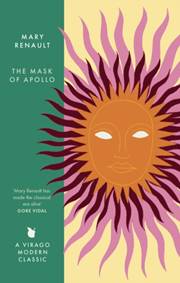
The Mask of Apollo
Knihu kúpite v
1 e-shope
od
15,15 €
Ak sa vám po kliknutí na tlačidlo "Do obchodu" nezobrazí stránka knihy vo vybranom e-shope, je potrebné vypnúť AdBlock vo vašom prehliadači pre našu stránku.
Návod na vypnutie je napríklad na adrese https://www.sme.sk/dok/20466299/ako-vypnut-adblock-na-sme-sk-whitelist.
Krátky popis
'Mary Renault is a shining light to both historical novelists and
their readers. She does not pretend the past is like the present,
or that the people of ancient Greece were just like us. She shows
us their strangeness, discerning, sure-footed, challenging our
values, piquing our curiosity, she leads us through an alien
landscape that moves and delights us' HILARY MANTEL'Mary Renault's
portraits of the ancient world are fierce, complex and eloquent,
infused at every turn with her life-long passion for the
Classics.Her characters live vividly both in their own time, and in
ours' MADELINE MILLERCombining the scholarship of a historian with
the imagination of a novelist, Mary Renault brings the ancient
Greek stage thrillingly to life. Set in fourth-century B.C. Greece,
The Mask of Apollo is narrated by Nikeratos, a tragic actor who
takes with him on all his travels a gold mask of Apollo, a relic of
the theatre's golden age, which is now past.At first his mascot,
the mask gradually becomes his conscience, and he refers to it his
gravest decisions, when he finds himself at the centre of a
political crisis in which the philosopher Plato is also involved.
Much of the action is set in Syracuse, where Plato's friend Dion is
trying to persuade the young tyrant Dionysios the Younger to accept
the rule of law. Through Nikeratos' eyes, the reader watches as the
clash between the two unleashes all the pent-up violence in the
city.'All my sense of the ancient world - its values, its style,
the scent of its wars and passions - comes from Mary Renault. I
turned to writing historical fiction because of something I learned
from Renault: that it lets you shake off the mental shackles of
your own era, all the categories and labels, and write freely about
what really matters to you' EMMA DONOGHUE 'There's much to wonder
at in the way she fills in the large dark spaces where we know next
to nothing about the times she describes . .&,nbsp,. an
important and wonderful writer . .&,nbsp,. she set a course
into serious-minded, psychologically intense historical fiction
that today seems more important than ever' - Sam Jordison, Guardian



Výber kníh vydavateľa
Slovart
Zobraziť všetky knihy vydavateľa
Slovart
Naše tipy