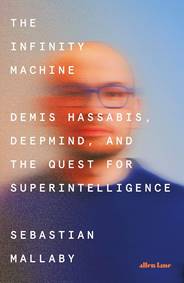
The Infinity Machine
Knihu kúpite v
1 e-shope
od
23,70 €
Ak sa vám po kliknutí na tlačidlo "Do obchodu" nezobrazí stránka knihy vo vybranom e-shope, je potrebné vypnúť AdBlock vo vašom prehliadači pre našu stránku.
Návod na vypnutie je napríklad na adrese https://www.sme.sk/dok/20466299/ako-vypnut-adblock-na-sme-sk-whitelist.
Krátky popis
'Extraordinary... beautifully written, clear-eyed and engaged in
the deepest ethical questions of our day' Rory StewartA revelatory
portrait of the visionary behind Google DeepMind, the race to
control the future – and what it means to winEven in a tech world
crowded with visionary leaders, Demis Hassabis is recognized as a
special case. Born to working class, immigrant parents in North
London, a chess prodigy by five and wizard coder in his teens, he
turned down a seven-figure job offer from a video-game studio to
study science at Cambridge. Long before the current obsession with
AI, he founded the path-breaking company DeepMind in order to
pursue a single, audacious goal: the dream of artificial
superintelligence, which would solve humanity’s hardest problems,
change life and work as we know it, and perhaps even unlock the
deepest mysteries of the Universe. For his scientific achievements,
he won a Nobel Prize in 2024, and his company, now Google DeepMind,
is considered the tech giant’s engine room. For the past three
years, Sebastian Mallaby has had unprecedented access to Hassabis
and DeepMind, conducting hundreds of hours of interviews with him
and his inner circle as well as detractors and rivals at other
companies. The result is a revelation-packed portrait of a singular
mind and a historic reckoning with the AI revolution, a shift
potentially more significant than any since the dawn of complex
thought 70,000 years ago. As Mallaby chronicles, DeepMind is locked
in an arms race with Silicon Valley competitors to build artificial
general intelligence, and thereby become the keeper of humanity’s
future. Yet this is not a Silicon Valley story. Hassabis has
remained in Britain, and unlike his rivals, his aims are not wealth
and power but scientific enlightenment. Like them, however, he is
haunted by the memory of Robert Oppenheimer, the creator of the
atom bomb. He aims to control the technology, but the technology
may ultimately control him – and humanity writ large.
Výber kníh autorov
Allen Lane ,
Mallaby Sebastian








Zobraziť všetky knihy autora
Allen Lane,
Mallaby Sebastian
Výber kníh vydavateľa
Slovart

Zobraziť všetky knihy vydavateľa
Slovart
Naše tipy