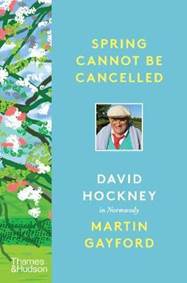
Spring Cannot be Cancelled
Knihu kúpite v
1 e-shope
od
30,35 €
Ak sa vám po kliknutí na tlačidlo "Do obchodu" nezobrazí stránka knihy vo vybranom e-shope, je potrebné vypnúť AdBlock vo vašom prehliadači pre našu stránku.
Návod na vypnutie je napríklad na adrese https://www.sme.sk/dok/20466299/ako-vypnut-adblock-na-sme-sk-whitelist.
Krátky popis
'I intend to carry on with my work, which I now see as very
important. We have lost touch with nature rather foolishly as we
are a part of it, not outside it' David Hockney On turning eighty,
David Hockney sought out rustic tranquility for the first time: a
place to watch the sunset and the change of the seasons, a place to
live a life of simple pleasures, undisturbed and undistracted, a
place to keep the madness of the world at bay. So when Covid-19 and
lockdown struck, it made little difference to life at La Grande
Cour, the centuries-old Normandy farmhouse where Hockney set up a
studio a year before, in time to paint the arrival of spring.In
fact, he relished the enforced isolation as an opportunity for even
greater devotion to his art. Spring Cannot be Cancelled is an
uplifting manifesto that affirms art's capacity to divert and
inspire. It is based on a wealth of new conversations and
correspondence between Hockney and the art critic Martin Gayford,
his long-time friend and collaborator.Their exchanges are
illustrated by a selection of Hockney's new, unpublished Normandy
drawings and paintings alongside works by van Gogh, Monet, Bruegel
and others. We see how Hockney is propelled ever forward by his
infectious enthusiasms and sense of wonder. A lifelong contrarian,
he has been in the public eye for sixty years, yet remains entirely
unconcerned by the view of critics or even history.He is utterly
absorbed by his four acres of northern France and by the themes
that have fascinated him for decades: light, colour, space,
perception, water, trees. He has much to teach us, not only about
how to see ... but about how to live.
Výber kníh autora
neuvedený autor




Zobraziť všetky knihy autora
neuvedený autor
Výber kníh vydavateľa
Slovart
Zobraziť všetky knihy vydavateľa
Slovart
Naše tipy