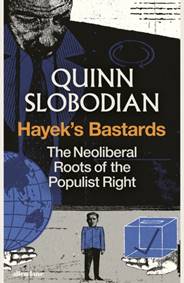
Hayek's Bastards
Knihu kúpite v
1 e-shope
od
30,35 €
Ak sa vám po kliknutí na tlačidlo "Do obchodu" nezobrazí stránka knihy vo vybranom e-shope, je potrebné vypnúť AdBlock vo vašom prehliadači pre našu stránku.
Návod na vypnutie je napríklad na adrese https://www.sme.sk/dok/20466299/ako-vypnut-adblock-na-sme-sk-whitelist.
Krátky popis
A revelatory exploration of how today’s right-wing authoritarianism
emerged not in opposition to neoliberalism, but from within
itBracingly original... Hayek’s Bastards demonstrates how a history
of ideas can be riveting. Slobodian grounds intellectual
abstractions in the lives of the people who espoused them...His
book offers an illuminating history to our current bewildering
moment, as right-wing populists join forces with billionaire
oligarchs to take a chain saw to the foundations of public life,
until there’s nothing left to stand on' - Jennifer Szalai, The New
York TimesAfter the end of the Cold War, neoliberalism, with its
belief in the virtues of markets and competition, seemed to have
triumphed. Communism had been defeated – and Friedrich Hayek, the
spiritual father of neoliberal economics, had just about lived to
see it. But in the decades that followed, Hayek’s disciples knew
that they had a problem.The rise of social movements, from civil
rights and feminism to environmentalism, were now proving
roadblocks in the road to freedom, nurturing a culture of
government dependency, public spending, political correctness and
special pleading. Neoliberals needed an antidote. In this
illuminating new book, historian Quinn Slobodian reveals how, from
the 1990s onwards, neoliberal thinkers turned to nature, in an
attempt to roll back social changes and to return to a hierarchy of
gender, race and cultural difference.He explores how these thinkers
drew on the language of science, from cognitive psychology to
genetics, in order to embed the idea of ‘competition’ ever deeper
into social life, and to advocate cultural homogeneity as essential
for markets to truly work. Reading and misreading the writings of
their sages, Friedrich Hayek and Ludwig von Mises, they forged the
alliances with racial psychologists, neo-confederates,
ethnonationalists that would become known as the alt-right. Hayek’s
Bastards shows that many contemporary iterations of the Far Right,
from Javier Milei to Donald Trump, emerged not in opposition to
neoliberalism, but within it.As repellent as their politics may be,
these supposed disruptors are not defectors from the neoliberal
order, but its latest cheerleaders.
Výber kníh autorov
Penguin Books Ltd ,
Quinn Slobodian








Zobraziť všetky knihy autora
Penguin Books Ltd,
Quinn Slobodian
Výber kníh vydavateľa
Slovart


Zobraziť všetky knihy vydavateľa
Slovart
Naše tipy