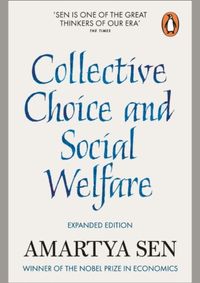
Collective Choice and Social Welfare
Knihu kúpite v
1 e-shope
od
18,00 €
Ak sa vám po kliknutí na tlačidlo "Do obchodu" nezobrazí stránka knihy vo vybranom e-shope, je potrebné vypnúť AdBlock vo vašom prehliadači pre našu stránku.
Návod na vypnutie je napríklad na adrese https://www.sme.sk/dok/20466299/ako-vypnut-adblock-na-sme-sk-whitelist.
Krátky popis
Nobel Prize winner Amartya Sen's first great book, now reissued in
a fully revised and expanded second edition 'Can the values which
individual members of society attach to different alternatives be
aggregated into values for society as a whole, in a way that is
both fair and theoretically sound? Is the majority principle a
workable rule for making decisions? How should income inequality be
measured? When and how can we compare the distribution of welfare
in different societies?' These questions, from the citation by the
Swedish Academy of Sciences when Amartya Sen was awarded the Nobel
Memorial Prize in Economics, refer to his work in Collective Choice
and Social Welfare, the most important of all his early books.
Originally published in 1970, this classic work in welfare
economics has been recognized for its ground-breaking role in
integrating economics and ethics, and for its influence in opening
up new areas of research in social choice, including aggregative
assessment. It has also had a large influence on international
organizations, including the United Nations, particularly in its
work on human development. In its original version, the book showed
that the 'impossibility theorems' in social choice theory-led by
the pioneering work of Kenneth Arrow-need not be seen as
destructive of the possibility of reasoned and democratic social
choice. Sen's ideas about social choice, welfare economics,
inequality, poverty and human rights have continued to evolve since
the book's first appearance. This expanded edition, which begins by
reproducing the 1970 edition in its entirety, goes on to present
eleven new chapters of new arguments and results. As in the
original version, the new chapters alternate between
non-mathematical chapters completely accessible to all, and those
which present mathematical arguments and proofs. The reader who
prefers to shun mathematics can follow all the non-mathematical
chapters on their own, to receive a full, informal understanding.
There is also a substantial new introduction which gives a superb
overview of the whole subject of social choice.
Výber kníh autorov
Penguin ,
Amartya Sen








Zobraziť všetky knihy autora
Penguin,
Amartya Sen
Výber kníh vydavateľa
Slovart

Zobraziť všetky knihy vydavateľa
Slovart
Naše tipy