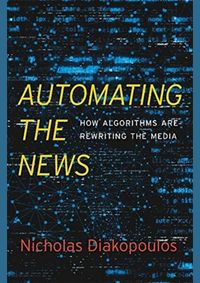
Automating the News: How Algorithms Are Rewriting the Media
Knihu kúpite v
1 e-shope
od
28,03 €
Ak sa vám po kliknutí na tlačidlo "Do obchodu" nezobrazí stránka knihy vo vybranom e-shope, je potrebné vypnúť AdBlock vo vašom prehliadači pre našu stránku.
Návod na vypnutie je napríklad na adrese https://www.sme.sk/dok/20466299/ako-vypnut-adblock-na-sme-sk-whitelist.
Krátky popis
From hidden connections in big data to bots spreading fake news,
journalism is increasingly computer-generated. An expert in
computer science and media explains the present and future of a
world in which news is created by algorithm. Amid the push for
self-driving cars and the roboticization of industrial economies,
automation has proven one of the biggest news stories of our
time.Yet the wide-scale automation of the news itself has largely
escaped attention. In this lively expose of that rapidly shifting
terrain, Nicholas Diakopoulos focuses on the people who tell the
stories-increasingly with the help of computer algorithms that are
fundamentally changing the creation, dissemination, and reception
of the news. Diakopoulos reveals how machine learning and data
mining have transformed investigative journalism.Newsbots converse
with social media audiences, distributing stories and receiving
feedback. Online media has become a platform for A/B testing of
content, helping journalists to better understand what moves
audiences. Algorithms can even draft certain kinds of stories.These
techniques enable media organizations to take advantage of
experiments and economies of scale, enhancing the sustainability of
the fourth estate. But they also place pressure on editorial
decision-making, because they allow journalists to produce more
stories, sometimes better ones, but rarely both. Automating the
News responds to hype and fears surrounding journalistic algorithms
by exploring the human influence embedded in automation.Though the
effects of automation are deep, Diakopoulos shows that journalists
are at little risk of being displaced. With algorithms at their
fingertips, they may work differently and tell different stories
than they otherwise would, but their values remain the driving
force behind the news. The human-algorithm hybrid thus emerges as
the latest embodiment of an age-old tension between commercial
imperatives and journalistic principles.
Výber kníh autora
neuvedený autor








Zobraziť všetky knihy autora
neuvedený autor
Výber kníh vydavateľa
Slovart

Zobraziť všetky knihy vydavateľa
Slovart
Naše tipy