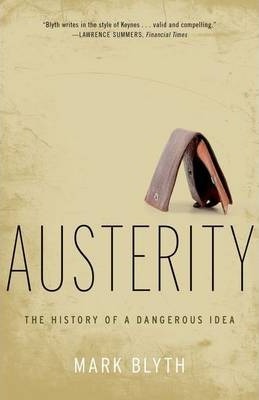
Austerity
Mark (Professor of Political Economy,
Professor of Political Economy,
Brown University) Blyth,
Oxford University Press Inc
Knihu kúpite v
1 e-shope
od
15,15 €
Ak sa vám po kliknutí na tlačidlo "Do obchodu" nezobrazí stránka knihy vo vybranom e-shope, je potrebné vypnúť AdBlock vo vašom prehliadači pre našu stránku.
Návod na vypnutie je napríklad na adrese https://www.sme.sk/dok/20466299/ako-vypnut-adblock-na-sme-sk-whitelist.
Krátky popis
Selected as a Financial Times Best Book of 2013Governments today in
both Europe and the United States have succeeded in casting
government spending as reckless wastefulness that has made the
economy worse. In contrast, they have advanced a policy of
draconian budget cuts-austerity-to solve the financial crisis. We
are told that we have all lived beyond our means and now need to
tighten our belts.This view conveniently forgets where all that
debt came from. Not from an orgy of government spending, but as the
direct result of bailing out,recapitalizing, and adding liquidity
to the broken banking system. Through these actions private debt
was rechristened as government debt while those responsible for
generating it walked away scot free, placing the blame on the
state, and the burden on the taxpayer.That burden now takes the
form of a global turn to austerity, the policy of reducing domestic
wages and prices to restore competitiveness and balance the budget.
The problem, according to political economist Mark Blyth, is that
austerity is a very dangerous idea. First of all, it doesn't
work.As the past four years and countless historical examples from
the last 100 years show, while it makes sense for any one state to
try and cut its way to growth, it simply cannot work when all
states try itsimultaneously: all we do is shrink the economy. In
the worst case, austerity policies worsened the Great Depression
and created the conditions for seizures of power by the forces
responsible for the Second World War: the Nazis and the Japanese
military establishment. As Blyth amply demonstrates,the arguments
for austerity are tenuous and the evidence thin.Rather than
expanding growth and opportunity, the repeated revival of this dead
economic idea has almost always led to low growth along with
increases in wealth and income inequality. Austerity demolishes the
conventional wisdom, marshaling an army of facts to demand that we
austerity for what it is, and what it costs us.
Vývoj ceny
Aktuálna Ø cena knihy Austerity je 15,55 €
Výber kníh autorov
Mark (Professor of Political Economy ,
Professor of Political Economy ,
Brown University) Blyth ,
Oxford University Press Inc

Zobraziť všetky knihy autora
Mark (Professor of Political Economy,
Professor of Political Economy,
Brown University) Blyth,
Oxford University Press Inc
Výber kníh vydavateľa
Oxford


Zobraziť všetky knihy vydavateľa
Oxford
Naše tipy